
TL;DR

Get workout gear delivered free with Prime
- Fast, free delivery on millions of items
- Prime Video, Amazon Music and more included
- Member-only deals all year
A Fit&Well report describes a two-minute movement routine recommended by Steve Powell, Power Plate’s director of training and education, for breaking up sedentary work periods. The four 30-second steps use shoulder, chest, hip and back movements followed by a pause; Powell says the routine is not a cure for stress.
A Fit&Well report outlines a two-minute movement reset recommended by Steve Powell, Power Plate’s director of training and education, as a way to break up long periods of sitting and take a brief pause during the working day. The four-part routine uses gentle shoulder, chest, hip and back movements, followed by a moment of relaxed breathing; Powell cautions that it is not a cure for stress.
The routine is divided into four 30-second steps and does not require equipment, gym clothes or a dedicated exercise space, according to Powell. The first step is to let the shoulders drop, roll them backward and forward five times each, then gently draw the shoulder blades together and release. The report advises breathing naturally and noticing tension around the neck and upper back.
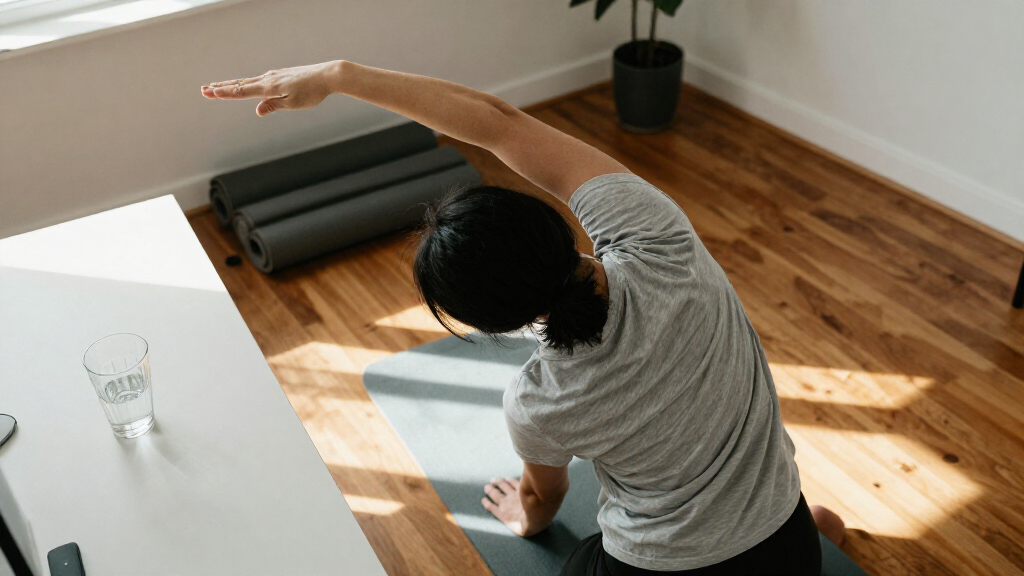
For the second step, stand with feet hip-width apart and gently open the arms to the sides, drawing the shoulders back. Hold the comfortable position briefly, relax and repeat. The third step combines gentle weight shifts from one foot to the other with slow standing side bends. The final 30 seconds are for standing comfortably, relaxing the arms and taking a few unhurried breaths before returning to work.
Powell advises keeping the movements controlled and within a comfortable range rather than forcing a stretch. The stated aim is to change position after sitting still, not to improve flexibility in two minutes or substitute for a longer workout. The report also suggests that small actions such as a short walk or shoulder rolls between meetings can make it easier to add movement to the day.
A Short Break From Deskbound Work
The suggestion addresses a routine workplace problem: long stretches of sitting can leave people feeling stiff, while busy schedules may make a full workout difficult to fit in. A brief sequence that can be done without equipment lowers the practical barrier to taking a movement break. It offers a simple interruption to the work routine, not evidence that a two-minute reset resolves the pressures causing stress.
That distinction matters. Powell says movement is not a cure for stress and that a brief pause cannot undo the effects of a demanding week. The more limited claim is that stepping away from a screen, changing posture and noticing how the body feels may help someone feel less stuck as they return to their tasks. The report does not present clinical research or measured outcomes for this particular routine.
Products Worth Considering

BowFlex Results Series SelectTech Adjustable Dumbbells (Pair)

Bowflex SelectTech 840 Adjustable Kettlebell

Blueair Blue Pure 511i Max Air Purifier
As an affiliate, we earn on qualifying purchases.
The Routine Behind Stress Awareness Day
The report links the advice to National Stress Awareness Day, which it says has been observed on the first Wednesday in November since 1998. The day is presented as a prompt to pause and consider everyday wellbeing, with work deadlines and the approaching holiday period among the pressures mentioned.
Powell is identified as a movement, performance and coaching specialist with more than 25 years of experience, and as a director at Power Plate, a company that makes whole-body vibration devices. His recommendation here does not require those devices. The routine is based on ordinary standing or seated movements and is described as an accessible way to interrupt a sedentary spell.
“Our bodies are designed to move, yet modern working life often encourages the opposite.”
— Steve Powell, director of training and education at Power Plate, speaking to Fit&Well
Limits of the Two-Minute Claim
The source does not provide a study evaluating this specific four-step sequence, data on its effects, or a comparison with other stress-management approaches. It is advice from a fitness specialist, not a reported clinical finding. The report does not establish how long any change in comfort or mood might last, or whether people will experience the same effect.
It also does not specify a publication date, beyond linking the advice to National Stress Awareness Day. People should stay within a comfortable range of motion and stop if a movement causes pain or discomfort. The report offers no individualized assessment for readers with injuries or health conditions.
How to Try the Reset Safely
The report offers the routine as an optional pause to try during a workday: complete each movement for about 30 seconds, keep it gentle and return to the task afterward. Readers can also choose a short walk or a few shoulder rolls, alternatives Powell mentions for breaking up inactivity. There is no follow-up study or measured outcome announced in the source; the immediate next step is simply to try a comfortable movement break and judge how it feels.
Key Questions
What are the four steps in the movement reset?
The sequence is shoulder rolls, a gentle chest-opening movement, hip weight shifts and standing side bends, then a short pause with relaxed breathing. The report assigns 30 seconds to each step.
Does the routine require equipment?
No. Powell says it can be done without specialist equipment, gym clothes or a dedicated space. The movements use a comfortable seated or standing position, though several steps are described standing.
Can two minutes solve everyday stress?
No. Powell says the routine will not solve every source of stress or undo a demanding week. He presents it as a brief opportunity to change posture, move and step away from whatever is occupying attention.
How should readers handle discomfort?
Keep movements controlled and within a comfortable range; the report specifically advises against forcing a stretch. Stop if a movement causes pain or discomfort, and seek professional guidance if an injury or health condition affects what movement is appropriate.
Source: fitandwell.com