
TL;DR

Get workout gear delivered free with Prime
- Fast, free delivery on millions of items
- Prime Video, Amazon Music and more included
- Member-only deals all year
Fit&Well published a six-exercise mobility routine designed by David Lloyd Clubs trainer Maxwell Thompson for people who spend extended periods at a desk or screen. The circuit includes back, shoulder, chest and hip movements; the trainer recommends three or four rounds, but the report does not provide evidence that the routine treats pain or improves posture.
Fit&Well has published a 15-minute mobility workout by David Lloyd Clubs trainer Maxwell Thompson, aimed at people who spend long stretches sitting at a desk or looking at a screen. The six-move circuit is intended to take the body through movements that desk work may leave out, though the article does not establish that it will treat back pain or correct posture.
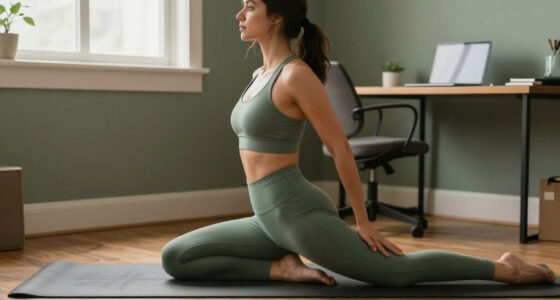
The routine uses six movements: cat-cow, thread the needle, band pull-apart, wall slide, half-kneeling hip flexor stretch and standing chest opener. Fit&Well says to perform the exercises in order as a circuit for three or four rounds, with rests of 30 seconds between moves. The workout uses repetitions for its first four movements and timed holds for the final two.
A long-loop resistance band is needed for the band pull-apart, although the report says a towel can be used to create tension in the upper back instead. Thompson suggests placing the routine in a lunch break or doing it when the body starts to feel stiff. He describes it as appropriate for beginners as well as people with more training experience.
The instructions emphasize controlled movement and comfortable ranges. For example, the wall slide is performed with the back against a wall, and the hip-flexor stretch calls for keeping the lower back from arching. These are workout directions and trainer guidance, not a guarantee of specific results. The source does not report a trial, measured outcomes or a comparison with other approaches.
A Short Break From Desk Positions
The circuit offers desk workers a structured movement break that can be done in roughly 15 minutes, without requiring a full workout session. It targets several areas named in the article’s description of desk-related stiffness, including the hips, chest, shoulders and mid-back. That may make it useful as a practical prompt to move during a workday, rather than remaining in one position for hours.
However, readers should distinguish the routine’s aim from a proven health outcome. Fit&Well presents it as a way to mobilize the body and ease the feeling of stiffness, but supplies no clinical evidence showing that this specific sequence reduces lower-back pain or improves posture. People with persistent pain, an injury or a health condition may need individualized advice rather than relying on a general workout.
resistance band for upper back exercises
As an affiliate, we earn on qualifying purchases.
As an affiliate, we earn on qualifying purchases.
The Six Moves and Their Order
Thompson’s sequence begins on hands and knees with cat-cow, followed by thread the needle, which rotates the upper body. The third exercise, band pull-apart, is performed standing or kneeling and focuses on pulling the arms apart against resistance. Each of those moves is listed for repetitions, with 30 seconds of rest after each.
The circuit then moves to wall slides, followed by a half-kneeling hip-flexor stretch held for 30 seconds per side and a standing chest opener held for 30 seconds. The report advises moving through a comfortable range and coordinating movement with breathing. Thompson is identified as a CIMSPA-certified personal trainer, an FRC-certified mobility specialist and a David Lloyd Academy Trainer. Fit&Well says he has specialized in mobility, strength and conditioning, and stress resilience since qualifying in 2018.
“It’s ideal for anyone who spends six-plus hours a day at their desk or screen.”
— Maxwell Thompson, David Lloyd Clubs trainer, speaking to Fit&Well
desk stretching and mobility equipment
As an affiliate, we earn on qualifying purchases.
As an affiliate, we earn on qualifying purchases.
Evidence and Individual Suitability
The report does not give a publication date, cite research testing this exact circuit or quantify how often users should do it. It also does not provide evidence that the routine will reduce lower-back tightness or improve posture for every desk worker. Those outcomes are part of the workout’s stated purpose, not measured findings in the source.
Individual comfort and ability can vary, and the article does not discuss modifications for injuries or medical conditions. The source advises a comfortable range of motion, but gives no detailed stop rules or professional screening guidance. Anyone whose symptoms persist or worsen should seek appropriate health advice rather than treating the routine as a substitute for assessment.
As an affiliate, we earn on qualifying purchases.
How Readers Can Use the Circuit
Fit&Well suggests trying the sequence during a lunch break or when stiffness sets in, following the listed order and completing three or four rounds. Readers who try it can adjust the movements to a comfortable range, use a towel if they do not have a resistance band, and stop if a movement causes pain. The source gives no follow-up schedule or outcome data, so whether the routine helps an individual remains a personal matter rather than a reported result.
adjustable dumbbells for home workouts
As an affiliate, we earn on qualifying purchases.
As an affiliate, we earn on qualifying purchases.
Key Questions
What exercises are in the 15-minute mobility routine?
The six moves are cat-cow, thread the needle, band pull-apart, wall slide, half-kneeling hip-flexor stretch and standing chest opener.
How many rounds does the workout call for?
Fit&Well says to complete the exercises in order as a circuit for three or four rounds, resting for 30 seconds between movements.
Do I need a resistance band?
The band pull-apart uses a long-loop resistance band. The report says a towel can be used as an alternative to create tension in the upper back.
Does the routine prove it can relieve back pain or improve posture?
No. The report describes those as aims of the workout but provides no trial results or measured evidence showing that this specific routine relieves pain or improves posture.
When does the trainer suggest doing it?
Thompson suggests fitting it into a lunch break or doing it when the body begins to feel stiff. The article does not specify a weekly frequency.
Source: rss
Halloween Picks
halloween
As an affiliate, we earn on qualifying purchases.