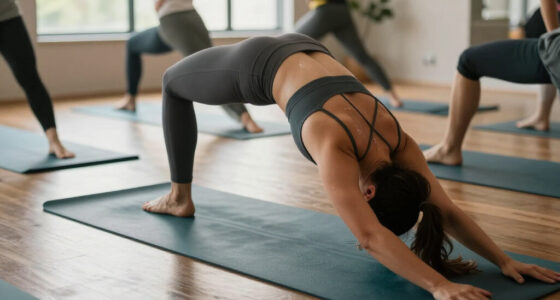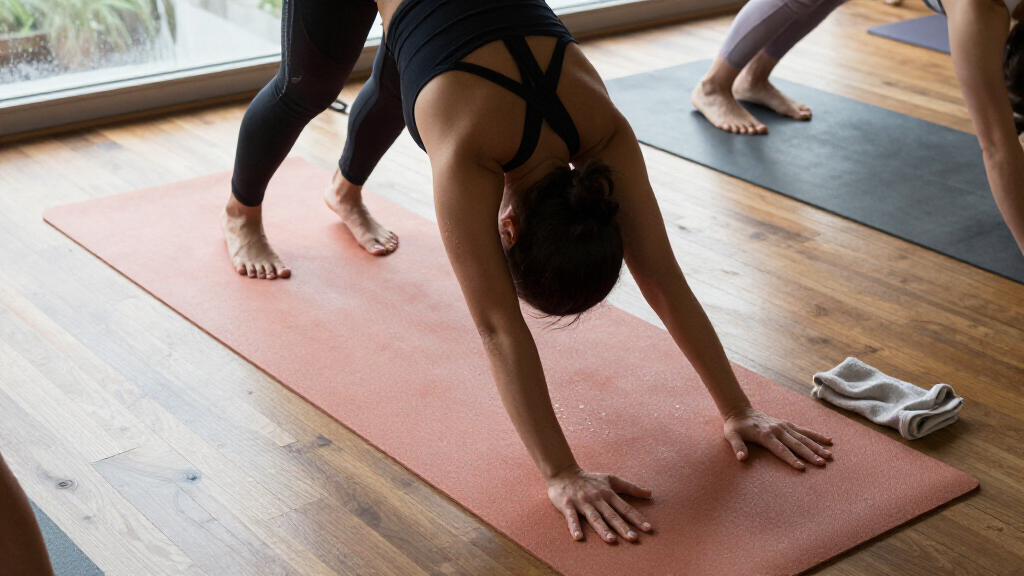

Choosing a yoga mat for heated practice is less about finding the softest surface and more about deciding how you want traction to behave once you start sweating. A microfiber-topped mat is designed to become grippier with moisture, making it appealing for vigorous, sweaty classes. A traditional rubber mat offers a more familiar, consistent surface and often better dry grip, but sweat can make it slippery unless you use a towel or a mat with a textured finish.

Get workout gear delivered free with Prime
- Fast, free delivery on millions of items
- Prime Video, Amazon Music and more included
- Member-only deals all year

IDIDI Heated Yoga Mat with Intelligent Temperature Control
- ✔ Brand: IDIDI
- ✔ Surface material: PU
- ✔ Heat settings: 3 levels: low, medium, high
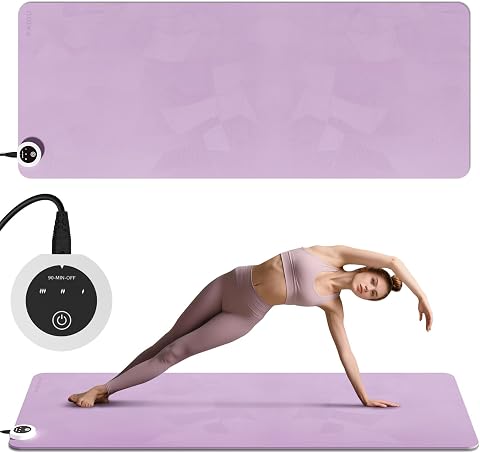
PAIDU Extra Large Electric Heating Yoga Mat
- ✔ Dimensions: 66 x 183 cm (26 x 72 inches)
- ✔ Thickness: 9 mm
- ✔ Surface material: PU leather

PAIDU Extra Large Electric Heating Yoga Mat (Deep Gray)
- ✔ Dimensions: 66 x 183 cm (26 x 72 inches)
- ✔ Thickness: 9 mm
- ✔ Color: Deep Gray
The tradeoff is practical: the microfiber option can help keep a separate towel from shifting, but it needs regular washing and may feel slick at the start of class. Rubber is often easier to use across heated and unheated sessions, though heavy sweating can call for an added towel. Choose microfiber if sweat-activated traction is your priority and you will keep up with care; choose rubber if you want a versatile everyday mat with dependable grip before you perspire.
At a Glance
| Criteria | Microfiber-topped yoga mat | Traditional rubber yoga mat | Winner |
|---|---|---|---|
| Grip when sweaty | Often improves as the microfiber surface absorbs moisture; a towel may still help in very sweaty classes. | Can become slippery under heavy sweat; texture and a separate towel can improve traction. | A |
| Grip when dry | Can feel slick before sweat builds, depending on the mat and surface treatment. | Usually provides more immediate traction, though performance differs by rubber compound and finish. | B |
| Cushioning and stability | Varies by construction; many microfiber mats use a rubber base that provides most of the support. | Often stable, with thickness choices that affect comfort and balance. | Depends |
| Care and drying | Top fabric usually needs frequent washing and thorough drying. | Typically easier to wipe down; allow it to air-dry and follow manufacturer instructions. | B |
| Versatility | Best suited to heated or sweaty sessions; dry classes may expose the grip limitation. | Usually works across heated and non-heated styles with fewer setup changes. | B |
| Value over time | Worth the extra care if the moisture-activated surface solves a real slipping problem. | Often a strong all-purpose purchase; a towel adds cost if classes are very sweaty. | Depends |
IDIDI Heated Yoga Mat with Intelligent Temperature Control
The IDIDI earns our top spot because its feature set is presented specifically around heated yoga and meditation rather than general floor warming. We get three adjustable heat levels and a 90-minute automatic timer, which gives us a straightforward way to tailor warmth and set a shutoff window for a session. Its PU surface is described as comfortable and non-slip, a relevant combination for floor poses where stable hand and foot placement matters.Compared with the PAIDU mats, the IDIDI listing is less complete on dimensions, thickness, and safety details: it does not state an overall size, overheat protection, or certifications. The PAIDU options, by contrast, specify a 66 x 183 cm footprint, 9 mm thickness, and additional safety features. That makes PAIDU the more documented choice for coverage and stated protections, while IDIDI is the more focused pick if we want a simple yoga-oriented heated surface with adjustable warmth.There are important limits. The mat requires electricity, so it is not a flexible grab-and-go replacement for a standard mat, and the available product information offers limited evidence about long-term durability. The non-slip claim also should not be mistaken for confirmed grip during very sweaty sessions; no sweat-specific test information is provided. We would choose it for controlled, at-home warmth, not as a proven hot-yoga studio surface.
Pros:
- Three heat settings let us choose among low, medium, and high warmth.
- PU surface is described as comfortable and non-slip for floor practice.
- 90-minute automatic timer provides a defined shutoff period.
- Designed with winter practice and meditation in mind.
Cons:
- Needs an electrical connection, limiting use away from an outlet.
- Dimensions and thickness are not stated in the supplied specifications.
- Long-term durability and performance during heavy perspiration are not established.
Best for: Home practitioners who want adjustable warmth and a yoga-focused PU surface without prioritizing extra-large dimensions.
Not ideal for: People who need a portable unpowered mat, require stated overheat protection or certifications, or want documented dimensions before buying.
Bottom line: We recommend the IDIDI as the most yoga-focused option here, provided adjustable warmth matters more than a fully specified size and safety-feature list.
“We recommend the IDIDI as the most yoga-focused option here, provided adjustable warmth matters more than a fully specified size and safety-feature list.”
PAIDU Extra Large Electric Heating Yoga Mat
When coverage is our priority, the PAIDU Extra Large has the clearest case. Its 66 x 183 cm footprint gives us a full-length heated area, while the stated 9 mm thickness adds cushioning compared with the IDIDI, whose thickness is not provided. It is also positioned for Pilates and general home use, so this is the most versatile pick if the mat needs to serve beyond yoga sessions.Its listed construction pairs a waterproof PU leather surface with a slip-resistant TPE bottom. The description also calls out three temperature settings, a 90-minute auto-shutoff, and overheat protection, plus CE and FCC certifications. Relative to the IDIDI, that is a more detailed specification set for size and safety. Those details help us compare the products, though they do not tell us how evenly warmth is distributed or how secure the top surface feels during sweaty transitions.We should plan for a more constrained setup than with a standard mat. PAIDU says the unit must sit on a flat surface to protect its internal heating chips, and it cannot be covered with blankets while operating. It is also a 120V electric product, so it needs a suitable outlet and is not a travel-friendly substitute for an unheated mat. Compared with the Deep Gray version, the listed core features are effectively the same; choose this listing for its presentation or availability, not an assumed performance advantage.
Pros:
- 66 x 183 cm dimensions provide more specified coverage than the IDIDI listing.
- 9 mm thickness and a TPE bottom are stated in the product specifications.
- Three temperature settings and a 90-minute auto-shutoff support adjustable sessions.
- Overheat protection, waterproof surface, and CE and FCC certifications are listed.
Cons:
- Must be placed flat to avoid risking damage to internal heating components.
- Cannot be covered with blankets while in use.
- Electric operation limits portability and depends on an appropriate outlet.
Best for: Practitioners who want a full-length heated surface for yoga or Pilates and value stated overheat protection and broader household use.
Not ideal for: Buyers who need portability, want to use a mat under blankets, or cannot provide a flat surface near a compatible outlet.
Bottom line: Choose this PAIDU if we want a generously sized, multipurpose heated mat with more explicitly listed safety features than the IDIDI.
“Choose this PAIDU if we want a generously sized, multipurpose heated mat with more explicitly listed safety features than the IDIDI.”
PAIDU Extra Large Electric Heating Yoga Mat (Deep Gray)
The Deep Gray PAIDU is the straightforward choice when we want the same large heated format in a specific color. Its listed 66 x 183 cm size, 9 mm thickness, PU leather surface, and TPE underside match the other PAIDU listing. It also includes three adjustable temperature settings, a 90-minute automatic shutdown, overheat protection, and CE and FCC certifications. In practical terms, the supplied descriptions do not show a meaningful feature advantage over the other color listing.Against the IDIDI, the Deep Gray option is better documented for dimensions and construction, and it is explicitly described as useful for yoga, exercise, or warming a living-room floor. That broader role may suit a household that wants one electric surface for several activities. The tradeoff is that it remains a large, cord-dependent mat with use conditions: keep it flat to avoid damaging internal components, and do not cover it with blankets while heating.We would not pay attention to the color as a signal of different performance: the given details identify the PAIDU models as near-equivalent in their core specifications. The Deep Gray version makes sense if its appearance better fits our room or if this listing is the available one. As with the other options, the product information does not establish heat uniformity, sweat grip, or durability over extended use, so it is safest to treat it as a warming floor mat with yoga use rather than a verified high-sweat studio mat.
Pros:
- Large 66 x 183 cm format supports full-length floor activities.
- PU leather surface and TPE bottom are specified, along with 9 mm thickness.
- Three heat settings, 90-minute auto-off, and overheat protection are listed.
- Deep Gray finish offers an alternative appearance to the other PAIDU listing.
Cons:
- No meaningful performance distinction from the other PAIDU color listing is specified.
- Requires a flat surface and must remain uncovered during operation.
- Electrical dependence makes it less portable than a standard yoga mat.
Best for: Buyers who want the PAIDU’s full-length heated coverage and safety feature list in a Deep Gray finish for home yoga and general floor use.
Not ideal for: Shoppers seeking a distinct upgrade over the other PAIDU listing, a portable unheated mat, or a surface confirmed for very sweaty practice.
Bottom line: We would select the Deep Gray PAIDU for its finish and the same expansive, safety-featured setup—not for a stated functional advantage over its counterpart.
“We would select the Deep Gray PAIDU for its finish and the same expansive, safety-featured setup—not for a stated functional advantage over its counterpart.”
As an Amazon Associate we earn from qualifying purchases.
Key Differences
The defining difference is when each surface grips. Microfiber is intended to gain traction as moisture reaches the top layer. For people whose hands and feet sweat heavily, that can make a hot class feel more secure without constantly repositioning a separate towel. The catch is that a dry microfiber surface may not provide the same confidence, especially during the first poses or in a less sweaty session. Performance also varies by fabric, backing, and construction, so the material name alone is not a guarantee.
Rubber mats tend to be more predictable before sweat builds and more adaptable across different styles of yoga. But once perspiration pools, a rubber surface can lose traction, and some practitioners will need a towel or a mat designed with a more textured finish. Care and value follow the same split: microfiber often needs more laundry and drying time, while rubber is usually simpler to maintain. The better buy depends on whether you need sweat-responsive grip badly enough to accept that upkeep, or would rather use one versatile mat and add a towel when conditions demand it.
Detailed Comparison
Grip when sweaty (Microfiber-topped yoga mat wins — moderate)
Winner: Microfiber-topped mat, with a moderate advantage for heavy sweaters. Its surface is designed to become more secure as it gets damp, which can help during long holds and transitions when palms are wet. This can reduce the need to adjust a towel, though a towel may still be useful during especially intense sessions. Rubber can lose traction as sweat accumulates, so a towel or textured surface may be needed. For light sweaters, the gap may be small; for people who regularly slip, it can change the class experience.
Grip when dry (Traditional rubber yoga mat wins — moderate)
Winner: Traditional rubber mat, usually by a moderate margin. Rubber typically offers more immediate traction before sweat appears, which matters during warm-ups, gentle classes, and poses where the hands are dry. Microfiber can feel slick at first, so some users lightly dampen the surface or wait until perspiration builds. If your heated classes are mild or you do not sweat much, dry grip may matter more than sweat-activated grip.
Cushioning and stability (minor difference)
Winner: Depends on construction; the difference is usually minor between comparable models. Neither surface material alone tells you how comfortable or stable a mat will feel. Thickness, density, and the base layer matter more: extra padding can ease pressure on knees, while a thinner, firmer mat can feel steadier in standing poses. Many microfiber mats have a rubber base, so they may feel much like rubber mats of similar thickness. Compare specifications and, where possible, test the feel rather than choosing by top layer alone.
Care and drying (Traditional rubber yoga mat wins — moderate)
Winner: Traditional rubber, by a moderate margin. Rubber mats are generally straightforward to wipe down and air-dry, subject to the maker’s cleaning guidance. Microfiber surfaces can absorb sweat and often need more frequent washing; they also need to dry fully before storage. That is a real cost in time and convenience if you practice several days a week or carry a damp mat home. If you choose microfiber, check whether its care instructions allow machine washing before you buy.
Versatility across class styles (Traditional rubber yoga mat wins — moderate)
Winner: Traditional rubber, by a moderate margin. Rubber is generally easier to use for heated and unheated practice because its dry grip does not rely on sweat. A microfiber mat is more specialized: it can excel in sweaty sessions but feel less reassuring in a cool room or during a low-intensity class. If hot yoga is nearly your entire routine, that specialization may be an advantage rather than a drawback. For one mat that serves many settings, rubber is the safer choice.
Value over time (moderate difference)
Winner: Depends on how often you sweat and how you prefer to manage grip. A microfiber mat earns its keep when sweat-activated traction means fewer slips and less need to reposition a towel. But additional washing and drying add effort, and a lower-cost model may not deliver the surface performance you expect. Rubber is usually the better all-purpose value, though heavy sweaters may need to buy a separate towel. Pay more for microfiber only if its grip benefit addresses a repeated problem, not simply because the class is heated.
Microfiber-topped yoga mat: Pros and Cons
Pros:
- Can gain traction as sweat reaches the microfiber surface.
- May keep a separate towel from shifting during movement.
- A strong fit for frequent, vigorous hot yoga when sweat is the main grip issue.
Cons:
- May feel slick before the surface becomes damp.
- Often needs more frequent washing and complete drying.
- Less versatile for cool or low-sweat classes.
Traditional rubber yoga mat: Pros and Cons
Pros:
- Usually provides more immediate grip in dry conditions.
- Works across heated and unheated practice with fewer adjustments.
- Often simpler to wipe down and maintain.
Cons:
- Heavy sweat can reduce traction.
- A separate towel may be needed for very sweaty sessions.
- Comfort and stability vary by thickness and rubber construction.
Who Should Choose What
Choose Microfiber-topped yoga mat if:
- You sweat heavily and find that a standard rubber surface becomes slippery during hot yoga.
- You want a top layer that can gain grip with moisture and are willing to wash and dry it regularly.
- Most of your practice is vigorous and heated, so dry-room versatility is less important.
Choose Traditional rubber yoga mat if:
- You want one mat for heated classes, unheated yoga, and home practice.
- You value dependable traction before you start sweating and prefer simpler routine care.
- You sweat lightly or are comfortable adding a towel when a class gets very sweaty.
Skip both if: If you need very strong grip in both dry and heavily sweaty conditions but do not want to manage a washable surface or a towel, compare specialized textured mats and test their grip in person where possible.
Value for Money
Paying more for a microfiber-topped mat is worthwhile when you sweat enough that a conventional surface regularly causes slipping, and the moisture-responsive grip improves confidence in poses. It is harder to justify the extra cost and care if you only attend occasional heated classes or do not sweat heavily. In those cases, a traditional rubber mat plus a yoga towel when needed is often the better-value setup. Rubber is also the more flexible purchase if you expect to use the same mat for several styles of practice. Compare actual construction, care instructions, and thickness alongside the material: a premium label does not by itself mean better traction.
Final Verdict
For most people buying one mat for mixed use, choose traditional rubber. It is generally more dependable while dry, easier to care for, and more adaptable beyond hot yoga. Add a towel for classes where sweat compromises grip. Choose microfiber instead if you sweat heavily, spend most of your time in vigorous heated practice, and are willing to wash and fully dry the surface between sessions. The deciding factor is not simply whether a studio is hot; it is whether sweat makes your current grip unreliable. Pay extra for microfiber only when that specific benefit matters enough to outweigh its dry-grip and upkeep tradeoffs.
Frequently Asked Questions
Is a microfiber yoga mat always grippier in hot yoga?
No. It is designed to gain traction with moisture, but the result depends on the mat’s fabric, backing, and how much you sweat. Some surfaces feel slick while dry, and a towel may still help during very sweaty classes. Follow the maker’s instructions for preparing and cleaning the mat.
Will a rubber yoga mat become slippery when wet?
It can. Sweat and pooled moisture may reduce traction, although rubber compounds and surface textures differ. If you slip during practice, try a compatible yoga towel or compare mats with a finish designed for sweaty use.
Is a separate yoga towel necessary with either option?
Not always. A microfiber mat may provide enough grip for some practitioners as it becomes damp, while others still prefer a towel for heavy sweat or easier cleanup. Rubber-mat users are more likely to want one when perspiration affects their hand or foot placement.
Which mat is better for both hot and regular yoga?
A traditional rubber mat is usually the more versatile pick because its dry grip works in classes where you sweat little or not at all. If you choose rubber for hot yoga, plan for a towel if your practice gets sweaty enough to reduce traction.
Halloween Picks
halloween
As an affiliate, we earn on qualifying purchases.