TL;DR

Get workout gear delivered free with Prime
- Fast, free delivery on millions of items
- Prime Video, Amazon Music and more included
- Member-only deals all year
Boston-based Pilates instructor Julie Erickson recommends a three-move sequence—roll up and roll down, swan prep and spine twist—for people seeking to work on mobility and posture. The routine is an instructor’s recommendation, not evidence that three exercises quickly improve posture or reduce stiffness for everyone.
Pilates instructor Julie Erickson recommends a three-exercise sequence—roll up and roll down, swan prep and spine twist—as a way to work on mobility and posture. The Fit&Well report presents it as a practical routine for people who spend long periods sitting, but it does not provide study results showing how quickly the exercises change posture or reduce stiffness.
Erickson, identified by Fit&Well as a Boston-based instructor and founder of Endurance Pilates and Yoga, suggests practicing the movements regularly, much like the routine shared by another Pilates instructor. The report says the sequence is intended to build back strength and restore mobility, which may make upright sitting and standing easier. Those are the instructor’s stated aims, not measured outcomes reported in the article.
The first exercise, roll up and roll down, is listed for eight to 10 repetitions and is one of the low-impact movements featured in a Pilates home workout. From a seated position with the legs extended, the practitioner rolls the spine down toward the floor, reaches the arms overhead, then curls back up and folds forward over the legs. Fit&Well describes modifications: rolling down only partway or securing the feet under a strap or couch.
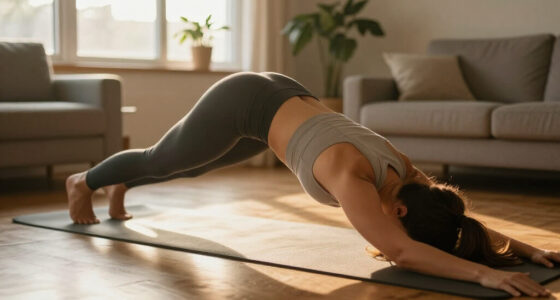
The remaining movements are prescribed for five repetitions each, with the spine twist performed on both sides. For swan prep, the practitioner lies face down, presses the hands into the mat and lifts the chest while drawing the shoulders back, then lowers slowly. The spine twist is done seated, rotating the ribcage while keeping the hips still. The source describes a more challenging swan option—lifting higher or straightening the arms—but gives no individualized assessment or evidence comparing results across versions.
A Short Routine, Not a Proven Shortcut
The sequence gives readers a specific starting point rather than a broad instruction to exercise more. It also includes repetition counts and easier variations, details that may help people adapt the movements to their current ability. For desk workers or others who feel stiff after prolonged sitting, that practical format may be useful when deciding what to try.
But the framing that it is the “quickest way” to improve goes beyond what the supplied report establishes. It does not describe a comparison with other routines, a test group, a time period, or before-and-after posture measurements. Readers should understand the recommendation as one instructor’s guidance, not a guarantee of fast results or a substitute for advice tailored to an injury or health condition.
Pilates resistance bands for home workouts
As an affiliate, we earn on qualifying purchases.
As an affiliate, we earn on qualifying purchases.
Three Movements in the Report
The report links the routine to everyday habits such as hours at a desk and looking down at a phone, which can encourage a rounded or fixed position. Its suggested response is a mix of spinal flexion, back extension and rotation: the roll-up sequence moves through flexion, swan prep emphasizes lifting the chest, and the twist adds rotation.
Fit&Well’s instructions give a basic sequence but do not specify how often to perform it, how long a session should last, or how to progress over several weeks. The article also does not set out a clinical definition of improved posture or stiffness. Those gaps matter when interpreting the recommendation: the instructions explain what to do, but they do not establish a standardized program or quantify its effects.
““restore mobility and strengthen your back””
— Fit&Well’s description of the routine’s intended effects
Pilates workout equipment for mobility and posture
As an affiliate, we earn on qualifying purchases.
As an affiliate, we earn on qualifying purchases.
Results and Timing Are Unreported
The supplied report does not say how quickly people might notice a change, how consistently the routine must be practiced, or whether the exercises were tested against other approaches. It gives no participant numbers, measurements or research citations to support a claim that this is the fastest method for improving posture or easing stiffness.
It is also unclear whether Erickson recommends the same sequence for people with back pain, limited mobility or other health concerns. The report offers movement instructions and modifications, but not screening guidance, safety criteria or individualized coaching. The exercises should not be treated as a diagnosis or treatment plan.
As an affiliate, we earn on qualifying purchases.
How Readers Can Use the Advice
Readers interested in trying the routine can follow the listed counts and begin with the easier options described for the roll-up and swan prep, keeping movements controlled rather than forcing range. The source does not provide a schedule or promise a particular result, so any change should be judged over time rather than assumed to happen quickly.
Anyone with pain, an existing injury or a condition that affects movement can ask a qualified health professional or Pilates instructor for guidance before starting. The next information needed to substantiate the “quickest” framing would be evidence comparing this sequence with other routines and reporting outcomes over a defined period.
Pilates exercise mat for back and posture
As an affiliate, we earn on qualifying purchases.
As an affiliate, we earn on qualifying purchases.
Key Questions
Which three exercises does Julie Erickson recommend?
She recommends roll up and roll down, swan prep, and spine twist, according to the Fit&Well report.
How many repetitions does the report suggest?
The roll up and roll down is listed for eight to 10 repetitions. Swan prep is listed for five, while the spine twist is five repetitions on each side.
Does the report prove this is the quickest way to improve posture?
No. The report attributes the recommendation to an instructor but provides no comparative study, measured results or timeline showing that the routine works faster than alternatives.
Are easier versions described?
Yes. Fit&Well says to roll down only halfway or secure the feet under a strap or couch for the roll-up exercise. It also describes a more challenging version of swan prep, but does not give individualized modifications for every reader.
Should someone with pain or an injury try the sequence?
The supplied report does not give specific guidance for people with pain or injuries. They should seek advice from a qualified health professional or instructor before beginning movements that may aggravate their condition.
Source: rss
Halloween Picks
halloween
As an affiliate, we earn on qualifying purchases.