Choose and prepare a yoga mat that stays supportive and manageable when heat and sweat make practice slippery. This guide is for beginners and regular students comparing mats or getting ready for a heated class. You will check the studio conditions, compare mat materials and surfaces, test the fit, and set up a simple cleaning routine. Allow about 20-30 minutes to choose and prepare a mat, then 5-10 minutes after class to clean it.

Get workout gear delivered free with Prime
- Fast, free delivery on millions of items
- Prime Video, Amazon Music and more included
- Member-only deals all year

IDIDI Heated Yoga Mat with Intelligent Temperature Control
- ✔ Brand: IDIDI
- ✔ Surface material: PU
- ✔ Heat settings: 3 levels: low, medium, and high
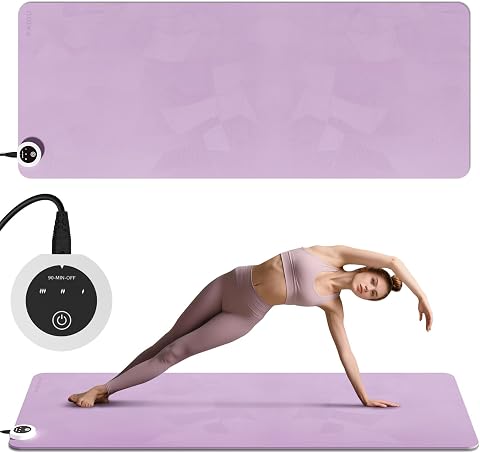
PAIDU Extra Large Electric Heating Yoga Mat
- ✔ Dimensions: 66 x 183 cm (26 x 72 inches)
- ✔ Thickness: 9 mm
- ✔ Surface material: PU leather

PAIDU Extra Large Electric Heating Yoga Mat (Deep Gray)
- ✔ Dimensions: 66 x 183 cm (26 x 72 inches)
- ✔ Thickness: 9 mm
- ✔ Color: Deep gray
Difficulty: Beginner | Time: 20-30 minutes to choose and prepare; 5-10 minutes after each class for cleaning
What You’ll Need
Tools & Materials:
- Access to the studio’s class or equipment information
- A tape measure or the mat’s listed length and width
- A clean towel for practice
- A mat cleaner approved by the mat manufacturer or a damp cloth
Knowledge:
- No yoga experience is required
- Know whether you prefer more cushioning or a closer connection to the floor
Check the studio’s rules before buying or bringing equipment. Some studios provide mats, require a towel, or restrict strong-smelling cleaners. Read the mat care label before applying any product. A mat suitable for heated practice should provide a stable surface when damp, but no mat can prevent every slip; use a towel and adjust poses if grip changes.
IDIDI Heated Yoga Mat with Intelligent Temperature Control
For buyers who want a heated mat rather than a general-purpose warming surface, the IDIDI Heated Yoga Mat is the most direct fit in this group. Its three adjustable heat levels give us a simple way to choose low, medium, or high warmth, and the automatic 90-minute timer adds a clear end point to a session. The PU surface is described as non-slip and comfortable, which is relevant for yoga; however, the listing does not provide a measured grip rating or detailed dimensions, so we should not assume it will suit every pose or body size equally well.Compared with the PAIDU mats, IDIDI is less fully documented on construction and protective features: the supplied details do not specify a TPE underside, overheat protection, or mat thickness. That makes the PAIDU listings easier to evaluate if safety layers and size are priorities. IDIDI still earns our lead position because its description is specifically centered on yoga, adjustable heat, and a PU practice surface. Its electric connection also means it is a home-use choice, not a convenient mat for studios or travel. We should treat its long-term durability as uncertain because little review information is provided.
Pros:
- Three heat settings allow adjustment across different rooms and practice preferences.
- PU surface is described as comfortable and non-slip for yoga use.
- Automatic 90-minute timer provides a defined shutoff point.
- Description focuses on keeping muscles warm for winter practice and meditation.
Cons:
- Requires electricity, limiting use away from a power source.
- Supplied specifications omit dimensions, thickness, and an overheat-protection claim.
- Limited long-term durability information makes lifespan difficult to assess.
Best for: Home practitioners who want a yoga-oriented PU surface, adjustable warmth, and a timed session without needing a stated extra-large format.
Not ideal for: Buyers who need confirmed dimensions, a specified anti-slip base, overheat protection, or an unpowered mat they can take anywhere.
Bottom line: We recommend IDIDI as the most yoga-focused pick, provided we are comfortable with fewer published construction and safety details than PAIDU supplies.
“We recommend IDIDI as the most yoga-focused pick, provided we are comfortable with fewer published construction and safety details than PAIDU supplies.”
PAIDU Extra Large Electric Heating Yoga Mat
PAIDU is the more spec-led choice when we want to know what will fit on the floor before ordering. At 66 x 183 cm and 9 mm thick, it has a stated full-length footprint for yoga and Pilates, and the PU leather surface is paired with a TPE bottom described as slip-resistant. That construction gives buyers more information than IDIDI provides about the underside and thickness. The product is also presented as a general home heating mat, so it may be a better match than IDIDI for households that want one powered surface for exercise and other floor use.The practical safeguards are a notable part of its appeal: PAIDU lists three temperature settings, a 90-minute auto-shutoff, and overheat protection. Those claims make the operating details clearer than IDIDI’s supplied specification set. The tradeoff is that this is not a carefree roll-out mat. It must sit on a flat surface to avoid damage to internal heating components, and it must not be covered with blankets while running. Those directions matter for yoga too, particularly if we usually layer props or textiles over a mat. Compared with the deep-gray PAIDU, the core dimensions and features are effectively the same; this standard listing wins the versatility role because its description explicitly names yoga, Pilates, and general home use.
Pros:
- 66 x 183 cm dimensions and 9 mm thickness are clearly specified.
- PU leather surface and TPE bottom provide more construction detail than IDIDI’s listing.
- Three heat settings, 90-minute auto-shutoff, and overheat protection are stated.
- Described for yoga, Pilates, and broader home use.
Cons:
- Requires a power source and is less portable than a standard yoga mat.
- Must be placed flat to help avoid damage to internal heating components.
- Cannot be covered with blankets during use, limiting layering options.
Best for: Home users who want a defined full-length heated surface for yoga, Pilates, or occasional general floor warmth, with stated shutoff and overheat safeguards.
Not ideal for: Anyone who needs a portable unpowered mat, wants to cover the surface during use, or cannot provide a flat placement area.
Bottom line: Choose this PAIDU when full-length coverage, multi-use potential, and explicitly stated safety features matter more than a yoga-only design.
“Choose this PAIDU when full-length coverage, multi-use potential, and explicitly stated safety features matter more than a yoga-only design.”
PAIDU Extra Large Electric Heating Yoga Mat (Deep Gray)
The deep-gray PAIDU is best understood as a finish choice within the same large-format approach as the standard PAIDU, not as a more advanced heating model. It shares the 66 x 183 cm dimensions, waterproof PU leather surface, TPE anti-slip bottom, three heat settings, and 90-minute automatic shutdown. The description also lists overheat protection and CE and FCC certifications. For buyers who have already decided that PAIDU’s size and operating rules suit their practice, the deeper color is the main visible reason to pick this version.That close match makes comparison straightforward: against IDIDI, this PAIDU provides more stated information about size, thickness, bottom material, and overheat protection, while IDIDI has a more explicitly yoga-centered pitch and simpler surface description. Against the standard PAIDU, however, the supplied specifications show no clear functional upgrade. We should choose the standard listing if its general-use framing better fits our household; choose deep gray if that finish better suits the room. As with its counterpart, this electric mat needs a flat surface and must remain uncovered during use, so it is less flexible than a conventional mat for layering or taking to class.
Pros:
- Full-length 66 x 183 cm format is specified for yoga and exercise.
- Waterproof PU leather surface and TPE anti-slip bottom are listed.
- Three heat settings, overheat protection, and 90-minute auto-off are stated.
- Deep-gray finish offers a darker alternative to the standard PAIDU listing.
Cons:
- Core listed features closely match the standard PAIDU, so color is the clearest differentiator.
- Requires flat placement and cannot be covered with a blanket while operating.
- Electric operation limits portability and dependence-free use.
Best for: Buyers who want PAIDU’s large heated format and listed safety features, and specifically prefer a deep-gray finish.
Not ideal for: Shoppers looking for a distinct performance improvement over the standard PAIDU, a travel-friendly mat, or a surface that can be covered while heating.
Bottom line: Pick the deep-gray PAIDU for its finish and large-format setup, but do not expect a stated functional advantage over the standard PAIDU.
“Pick the deep-gray PAIDU for its finish and large-format setup, but do not expect a stated functional advantage over the standard PAIDU.”
As an Amazon Associate we earn from qualifying purchases.
Before You Start
Find out whether the class is warm, hot, or particularly humid, and whether the studio supplies mats. Class temperature and personal sweating vary, so product descriptions alone cannot promise that a surface will feel secure. If you have a health condition affected by heat, ask a qualified health professional whether heated practice is appropriate. Bring water, follow the instructor’s guidance, and leave the room if you feel unwell.
Do not rely on a thick or absorbent mat to soak up sweat. A yoga towel placed over the mat can help manage moisture and provide a replaceable practice surface. Wash new mats as their labels direct; some need airing or a manufacturer-approved first clean before use.
Step-by-Step Instructions
Step 1: Check the studio setup
Ask the studio what temperature range the class uses, whether mats are supplied, and whether students should bring a full-size yoga towel. Check the floor surface and any equipment rules, including restrictions on sprays or scented products. Write down the mat dimensions the studio can accommodate if space is limited.
Tip: A class described as heated can mean different temperatures and humidity levels. Use the studio’s actual guidance rather than assuming every heated class is alike.
Check: You know what equipment to bring, whether a towel is expected, and whether the studio has size or cleaning restrictions.
Step 2: Choose a grippy, sweat-compatible surface
Compare mats whose manufacturers describe the surface as suitable for sweaty or heated practice. Look for a texture or coating intended to support grip when damp, and check the care instructions and material information. A textured natural-rubber or polyurethane surface may feel different from a closed-cell PVC or TPE surface; judge the specific mat rather than relying on material name alone. If possible, try the mat in person with clean, dry hands and feet, then check whether the surface feels stable rather than slick.
Tip: Materials and coatings differ between brands. Check for latex warnings if you have a latex allergy, and check the product’s odor and ventilation advice before bringing it into a small studio.
Check: The mat feels stable under your hands and feet, and its maker provides clear guidance for sweaty use and cleaning.
Step 3: Match thickness and size to your practice
Choose a length that lets you lie down without your head or feet extending beyond the mat, and a width that gives you room for your usual stance. Pick thickness based on the balance you need: more cushioning can help sensitive knees, while a thinner mat may feel steadier in standing poses and easier to carry. If you choose a thicker model, test whether it compresses or wobbles under your hands and feet.
Tip: Very soft cushioning can make balance work feel less stable. If you need extra knee support, use a folded towel under the knees instead of choosing a mat that feels unstable throughout class.
Check: You can lie down and take a wide stance on the mat, and it stays reasonably steady when you shift your weight.
Step 4: Select a towel and test the setup
Buy or borrow a yoga towel sized to cover the main contact area of your mat. Prefer a towel with corner pockets or another attachment method if it tends to bunch. Before class, lay it flat on the mat and test it with dry hands and feet. Follow its care label, and dampen it only if its maker recommends that for grip; some towels grip better when slightly damp, while others do not.
Tip: Do not assume a general bath towel will stay flat during movement. A dedicated yoga towel is designed to cover the mat and may include features that reduce bunching.
Check: The towel covers the area where you place your hands and feet and stays in place during a few controlled shifts.
Step 5: Clean and prepare the mat
Read the mat’s care label, then clean it using only the approved method. Use a lightly damp cloth or a mat-safe cleaner if permitted; do not soak the mat unless its manufacturer says it is safe. Wipe away residue and let the mat dry fully in a ventilated area before rolling it. Air out a new mat as directed, away from direct heat or sunlight if the care instructions warn against them.
Tip: Household disinfectants, essential oils, and abrasive scrubbers can damage some surfaces or leave residue that reduces grip. Do not combine cleaning products.
Check: The mat is dry, free of visible cleaner residue, and does not have a strong odor that could bother you or other students.
Step 6: Set up safely before class
Arrive with enough time to place your mat on a clean, level area with space around it. Spread the towel flat and attach its corners if available. Put water within reach, and check that the mat does not slide on the studio floor by pressing down gently at several points. If either the mat or towel shifts, reposition it or ask the instructor about a suitable alternative before practice begins.
Tip: Avoid using adhesive sprays or adding liquid to the mat unless the manufacturer and studio both allow it. A slippery floor or residue can create a fall risk.
Check: The mat lies flat, the towel does not bunch, and the setup stays in place under gentle pressure.
Step 7: Adjust during practice and clean afterward
Begin carefully and notice whether your hands, feet, mat, or towel become slick. Wipe your hands or use the towel as needed, and shorten or modify poses if you cannot hold them securely. After class, follow the mat and towel care labels: wash the towel as directed, wipe the mat with an approved method, and let both dry completely before storage. Store the mat loosely rolled or as its maker recommends.
Tip: Do not push through a pose when your grip is failing. Tell the instructor, step out of the pose, and reset your towel or position.
Check: You finish without the mat or towel repeatedly shifting, and the mat is clean and fully dry before it is put away.
Common Mistakes to Avoid
- Choosing a mat based only on its material name or claims such as non-slip. — Check the specific surface, damp-grip guidance, care label, and return policy. Test the feel when possible; brands use different finishes even with similar materials.
- Skipping a towel because the mat is marketed for hot yoga. — Bring a compatible yoga towel until you know how the mat performs during your class. Sweat levels and room conditions vary.
- Choosing extra-thick cushioning without testing stability. — Test standing balance and weight shifts before buying. Add a folded towel under sensitive knees when that gives you support without making the whole surface unstable.
- Cleaning with an unapproved spray or rolling up a damp mat. — Follow the maker’s care label, use no unapproved additives, and let the mat dry fully before storage.
Troubleshooting
Problem: Your hands or feet slide during poses.
Solution: Pause, wipe your hands and feet, flatten or reposition the towel, and modify the pose until you have secure footing. If slipping continues, ask the instructor for guidance and use a mat-towel combination designed for sweaty practice.
Problem: The towel bunches or moves across the mat.
Solution: Flatten it between poses and secure its corner pockets if it has them. Check that the towel matches the mat’s dimensions; replace it with a yoga towel that fits if it continues to shift.
Problem: The mat slides on the studio floor.
Solution: Stop practicing on the moving setup. Check for moisture or cleaner residue under the mat, dry the floor and mat as allowed, then test again. Ask the studio for a different location or approved equipment if movement persists.
Problem: The mat smells strongly or feels tacky after cleaning.
Solution: Stop using it until the surface is dry and residue-free. Follow the manufacturer’s cleaning directions, rinse only if permitted, and air it in a ventilated place. Contact the maker if the smell or tackiness remains.
What Success Looks Like
Your setup is ready when the mat fits your body and the studio space, feels stable under your hands and feet, and remains flat on the floor. The towel covers your main contact area without bunching. During class, you can adjust or modify poses rather than continuing when sweat makes your grip unreliable. Afterward, the mat has no visible residue and is completely dry before storage.
Next Steps
After each class, wash the towel according to its label and clean the mat using its approved method. Store both dry, away from direct heat if the mat maker advises against it. Check the surface periodically for peeling, cracks, persistent odor, or a change in grip. Replace the mat if damage or loss of traction makes practice unsafe. If the setup still feels slippery after testing a towel and approved cleaning, ask the studio or mat manufacturer for advice before buying another product.
Frequently Asked Questions
Do I need a yoga towel for heated practice?
A towel is a useful backup, especially if you sweat heavily or the mat becomes slick. Some mats perform well without one for some students, but room conditions and sweat vary. Ask the studio whether a towel is required and test your setup cautiously.
Is a thicker mat better for hot yoga?
Not automatically. Extra cushioning can support sensitive joints, but a very soft mat may feel unstable in standing or balancing poses. Choose the thinnest option that gives you adequate comfort and stable footing, or add a folded towel under specific pressure points.
Can I use any cleaner on my yoga mat?
No. Some cleaners, oils, and disinfectants can damage the surface or leave a slippery film. Follow the manufacturer’s care label and the studio’s rules, and let the mat dry fully before rolling it.
How often should I clean a mat used for heated classes?
Wipe it after each sweaty session using the approved method, and clean it more thoroughly at the interval stated by the maker. Wash the towel after each use according to its label. Let both dry fully to limit odor and material damage.
Fall Picks
fall essentials
As an affiliate, we earn on qualifying purchases.