TL;DR

Get workout gear delivered free with Prime
- Fast, free delivery on millions of items
- Prime Video, Amazon Music and more included
- Member-only deals all year
A Fit&Well report features a trainer who incorporates coordination exercises into sessions with older adults and describes three options: opposite-arm raises, side step-outs and a ball toss. The exercises can be modified for seated or standing practice, but the report does not establish that these specific routines extend lifespan or provide individual medical guidance.
A trainer who teaches older adults says they include coordination exercises in chair-based yoga classes and personal training, and has shared three adaptable movements for practicing coordinated arm and leg actions. The Fit&Well report describes the exercises as options for movement practice, not as a proven way to extend lifespan.
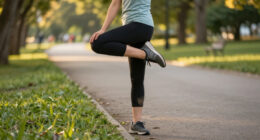
The trainer’s routine includes a knee lift with the opposite arm, a side step paired with an opposite-arm reach, and a ball toss and catch while balancing. The first two are suggested for five to six repetitions on each side; the ball exercise is listed for five to 10 repetitions. The source does not specify how often to do the sequence or how long a full session should last.
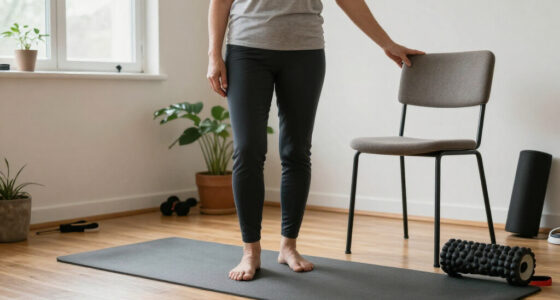
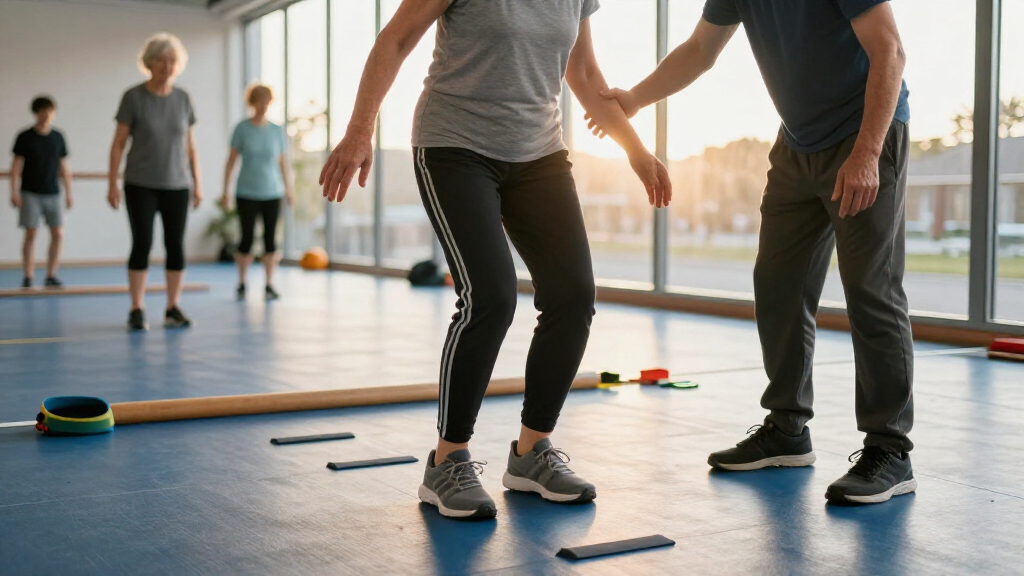
For the knee-and-arm movement, the standing version begins with feet hip-width apart and arms held out at shoulder height. The participant raises one knee and moves the opposite arm forward, then alternates. The trainer’s seated option is a controlled march, raising the opposite arm with each knee lift. For the step-out, participants step sideways and reach with the opposite arm; seated participants can move one leg to the side and open the opposite arm.
The ball exercise involves standing a few steps from a wall, lifting one foot and gently tossing a ball underhand so it bounces back to be caught. The report suggests changing the throw direction to vary the challenge. It also offers easier options: stand with both feet down, do the task seated, use one or two hands, or change the ball size. The source gives no testing data on how these specific exercises affect participants.
Coordination in Everyday Movement
The trainer says the exercises are intended to practice the connection between movement and attention, which may be relevant to tasks that involve moving while responding to the environment. The report gives examples such as manoeuvring around people on a bus and multitasking at home. These are the trainer’s explanation of the exercises’ purpose, not measured outcomes for every participant.
The practical point is that the activities have seated and standing variations, so the same basic movement pattern can be adjusted to different mobility levels. That flexibility may help instructors adapt a session, but it does not establish that every exercise is suitable for every person. The article also does not compare coordination training with other forms of exercise or show that it prevents falls, cognitive decline or other health conditions.
lightweight soft exercise ball for seniors hand eye coordination
As an affiliate, we earn on qualifying purchases.
As an affiliate, we earn on qualifying purchases.
What the Report Cites
The Fit&Well report says strength training is not the only activity relevant to aging well and describes coordination as a regular part of the trainer’s work with older adults. It refers to a 2019 review of balance and coordination exercises, which it says found improvements in cognitive processes such as spatial awareness, as well as postural control and stability in distracting environments.
The source material does not provide the review’s title, authors, participant numbers, study methods or the size and duration of reported effects. It also does not say that the 2019 review tested the three exercises in this report. The review is background cited by Fit&Well; it should not be read as proof that these exact movements produce the same outcomes for all older adults.
“I always incorporate coordination training into my chair-based yoga classes and personal training sessions with older adults, to fire up the mind-to-muscle connection.”
— The trainer, as quoted in Fit&Well
non-slip exercise mat for chair exercises and balance training
As an affiliate, we earn on qualifying purchases.
As an affiliate, we earn on qualifying purchases.
Evidence and Individual Suitability
The supplied report does not identify the trainer by name or provide independent testing of the three movements. It does not specify how often older adults should practice them, whether the exercises were studied as a set, or what outcomes participants achieved. The cited 2019 review is described only in general terms, so its methods and limitations cannot be assessed from the supplied material.
Individual ability, balance and health needs also vary. The report provides modifications but does not offer screening criteria or advice for people with pain, recent injuries, dizziness or other conditions. Readers should not treat the routine as individualized medical or rehabilitation guidance.
stable chair with arms for seated exercises seniors
As an affiliate, we earn on qualifying purchases.
As an affiliate, we earn on qualifying purchases.
Adapting the Routine Safely
The report gives no scheduled follow-up study or next publication milestone. Its immediate practical direction is to select a version that matches current mobility: seated marching and side reaches, standing movements with both feet grounded, or more challenging balance and ball variations. The trainer’s examples suggest beginning with controlled, manageable repetitions rather than treating the movements as a test.
People who are unsure whether a movement is appropriate can ask a qualified exercise professional or healthcare provider for guidance, particularly if they have a health condition or balance concerns. The source does not prescribe a universal progression, so any increase in difficulty should be based on the participant’s abilities and circumstances.
Key Questions
Which coordination exercises does the trainer recommend?
The report lists a knee lift with the opposite arm, a side step with an opposite-arm reach, and a ball toss and catch while balancing.
Can the movements be done seated?
Yes. The report suggests a seated march with opposite-arm movement, a seated side step with an arm opening, and a seated version of the ball activity.
Does the report show that these exercises extend lifespan?
No. It describes the trainer’s practice and refers to a 2019 review on balance and coordination exercises. It does not report evidence that these specific movements extend lifespan.
How many repetitions are suggested?
The report lists five to six repetitions on each side for the knee-and-arm raise and side step, and five to 10 repetitions for the ball exercise. It does not give a weekly schedule.
Should everyone try the standing balance version?
The report offers easier seated and two-feet-down alternatives, but it does not assess individual health or balance. People with concerns should seek guidance from a qualified professional before attempting a challenging version.
Source: rss
Halloween Picks
halloween
As an affiliate, we earn on qualifying purchases.