TL;DR

Get workout gear delivered free with Prime
- Fast, free delivery on millions of items
- Prime Video, Amazon Music and more included
- Member-only deals all year
Fit&Well published a five-move, squat-free Pilates routine for working the legs and glutes at home. The sequence uses body weight, calls for two rounds of 8 to 12 repetitions per side for each exercise, and can be made more challenging with optional ankle weights, according to Pilates instructor Lottie Anderson.
Fit&Well has published a five-move Pilates leg workout that can be done at home without squats, offering an alternative for people who find the movement uncomfortable or difficult. Pilates instructor Lottie Anderson, founder of London studio Bondi Rise, recommends two rounds of 8 to 12 repetitions per side for each move; ankle weights are optional.
The sequence consists of horse kicks, rainbow kicks, hamstring extensions, kneeling lifts and lowers, and kneeling side kicks. The first three begin on hands and knees. The final two use a supported kneeling side-plank position. Each exercise is performed on both sides, with Anderson’s instructions emphasizing controlled leg movement and keeping the hips or waist steady where specified.
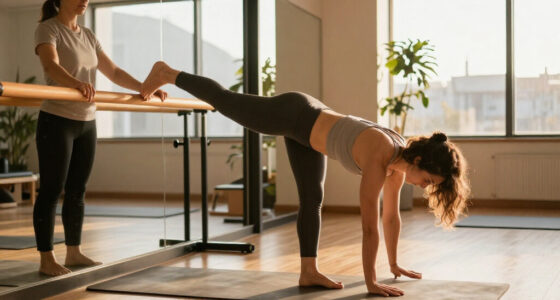
For a horse kick, extend one leg behind the body, then lift it toward hip height and lower it, keeping the hips stable. Rainbow kicks use a similar starting position, but the raised leg sweeps in an arc across the body and back to the other side. In the hamstring extension, bend the extended leg to draw the heel toward the glutes, then straighten it again. The source recommends keeping the thigh lifted throughout that exercise if possible.
For the last two moves, turn into a kneeling side plank with one hand and knee supporting the body. In the lift and lower, extend the upper leg and repeatedly raise and lower it. In the side kick, extend that leg in line with the hips, draw the knee toward the chest, then extend again. The report says Anderson uses ankle weights to increase the challenge, but describes them as unnecessary; it does not provide a comparison of results with and without added resistance.
A Squat-Free Option for Leg Training
The routine gives readers a specific lower-body workout without squats, rather than treating squats as the only route to leg exercise. The source notes that tight hamstrings, limited ankle mobility, balance difficulties or tender joints can make squatting uncomfortable or impractical. The five movements instead use a mat-based, mostly hands-and-knees setup, though the kneeling side-plank exercises still require balance and support from the arms and knees.
Anderson says the legs and glutes contribute to everyday tasks such as getting up and down, carrying a child and climbing stairs. She also says the glutes help stabilize the pelvis and support the lower back and knees. Those are the instructor’s explanations, not findings from a study included in the report. The article does not provide clinical evidence that this specific sequence prevents pain or injury, nor does it quantify strength gains.
For readers looking for a routine they can try at home, the practical details are clear: the moves require no squat and no required equipment, and the suggested volume is given for each side. That does not mean the sequence suits everyone. People should adapt or stop movements that cause pain, and anyone with an injury, health condition or concerns about exercise should seek advice from an appropriate health professional.
Products Worth Considering

Bowflex SelectTech 840 Adjustable Kettlebell

Philips Sonicare 5950 Rechargeable Electric Toothbrush with 2 Brush Heads, Pink

LEVOIT Vital 200S-P Smart Air Purifier for Large Rooms
As an affiliate, we earn on qualifying purchases.
Why the Routine Avoids Squats
Squats commonly feature in lower-body workouts, but they involve bending at the hips and knees while maintaining balance and sufficient movement through the ankles. Fit&Well’s report identifies tight hamstrings and limited ankle mobility as possible barriers to reaching depth, and says balance issues or tender joints can also make the exercise difficult. It presents the Pilates sequence as another way to work the lower body, not as a medical substitute or a claim that squats are unsuitable for everyone.
Anderson’s description focuses especially on the glutes and hamstrings. The horse kick and hamstring extension directly reflect that focus; the rainbow kick and side-lying-position variations add leg movement in different directions. The routine is based on Anderson’s instruction as reported by Fit&Well. The supplied material does not include a study, independent assessment or a comparison with other workouts.
“Your legs carry you through everything.”
— Lottie Anderson, Pilates instructor and founder of Bondi Rise, as quoted by Fit&Well
Limits of the Published Guidance
The source does not state when the routine was published, give evidence from a trial, or report how effective the five exercises are compared with squats or other lower-body workouts. It also does not offer modifications for people who cannot kneel comfortably, or explain how to adjust the routine for specific injuries or medical conditions. The suggested repetitions are general workout instructions, not an individualized plan.
It is also unclear how much resistance the optional ankle weights add, or whether using them changes outcomes. Readers should not interpret Anderson’s comments about posture, back support or knee tracking as proof that this sequence will treat or prevent pain. The report does not make that claim.
How to Use the Five Moves
The next step for anyone choosing to try the sequence is to follow the listed order and complete two rounds of 8 to 12 repetitions per side for each exercise, staying within a comfortable range of movement. The source suggests ankle weights only as an optional way to add resistance; readers can do the routine without them. It does not specify rest periods, a weekly schedule or a progression plan.
Fit&Well’s published instructions are the available guidance in the source material. No follow-up findings, professional review or additional safety modifications are provided. Anyone experiencing pain, struggling with the kneeling positions, or managing a pre-existing condition should pause and consult a qualified professional about suitable exercise options.
Key Questions
Which exercises are in the routine?
The five moves are horse kicks, rainbow kicks, hamstring extensions, kneeling lifts and lowers, and kneeling side kicks.
How many repetitions should I do?
Fit&Well’s instructions call for two rounds of 8 to 12 repetitions per side for each exercise.
Do I need ankle weights?
No. Anderson uses ankle weights to make the exercises harder, but the report says they are optional and are not needed to do the sequence.
Is the workout suitable for people with knee or back pain?
The report does not assess the routine for people with specific injuries or pain, and it does not claim the exercises treat or prevent either. Stop if a movement causes pain and seek guidance from a qualified health professional if you have a pre-existing condition or are unsure what is appropriate.
Source: fitandwell.com