
TL;DR

Get workout gear delivered free with Prime
- Fast, free delivery on millions of items
- Prime Video, Amazon Music and more included
- Member-only deals all year
A Fit&Well report describes two drills recommended by trainer Yancy Culp: walking very slowly to extend each one-foot transition, and performing slow high knees. Culp says regular practice can help balance, but the report does not provide research results or evidence that the drills prevent falls.
Fit&Well has reported two balance drills suggested by trainer Yancy Culp: walking at a deliberately slow pace and doing slow high knees. The exercises are intended to give people a way to practice balance and coordination, including those who are not yet comfortable standing on one leg.
Culp, identified in the report as a Spartan DEKA co-creator and senior director, recommends delayed walking for several minutes each day. The instruction is to walk slowly enough to spend longer balancing on one foot as each step moves into the next. He suggests gradually increasing the time spent in each step transition.
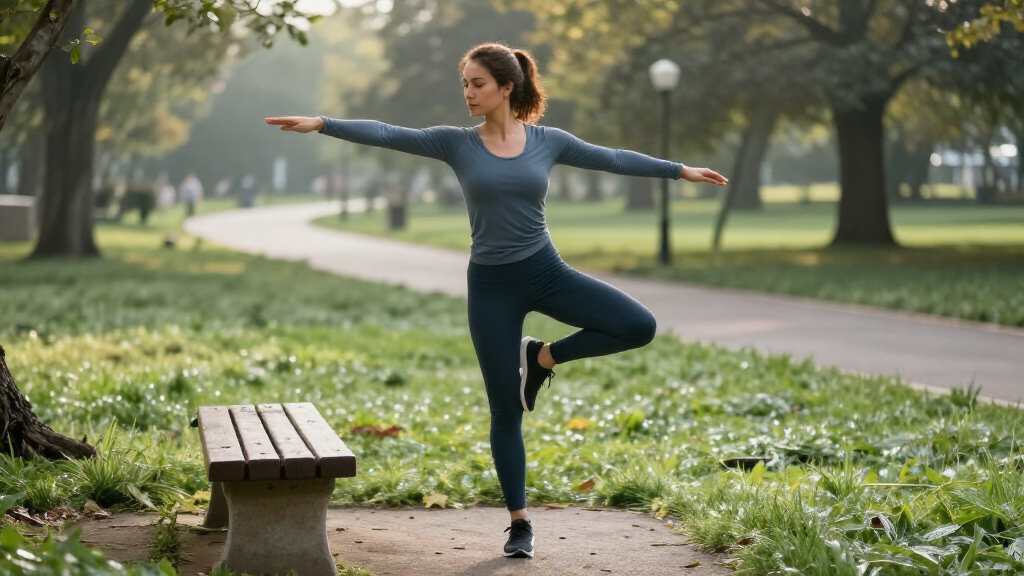
The second drill is slow high knees. Culp advises raising one knee slowly and taking three seconds to complete a leg cycle before returning the foot to the ground. The report says to continue for two minutes daily, then add one second to the cycle every fifth day. Its suggested progression reaches a 10-second cycle after 35 days.
The source also describes optional challenges, including briefly closing the eyes or reaching down to touch the foot during high-knee cycles. These are more demanding variations, not requirements for beginners. The report does not supply controlled-study results, an assessment protocol, or evidence that the exercises prevent falls.
Practice for Everyday Stability
Balance supports routine movement, from walking to dressing, and changes in steadiness can affect confidence in those tasks. Culp told Fit&Well that balance is connected to confidence in movement and becomes more important with age. Those are his professional views as presented in the report, rather than findings from a study included in the article.
The drills offer a low-equipment way to practice movements that require control on one leg. That may make them approachable for people seeking a starting point. However, an exercise suggestion is not a diagnosis or a guarantee of benefit. The report does not establish how much improvement a person should expect, or whether the drills are suitable for every fitness or health level.
balance training exercises for seniors
As an affiliate, we earn on qualifying purchases.
As an affiliate, we earn on qualifying purchases.
From One-Leg Tests to Drills
The report frames one-leg balance as one of five fitness checks Culp uses to help people consider different areas of fitness. The other areas he names are cardio fitness, strength and mobility. It gives tying a shoe while standing as an example of a task that combines balance and coordination.
The article’s author recounts being unable to put on a sock and shoe while balancing on one leg, then practicing by putting on socks standing on one foot. The author says the change took months and that balance improved. This is a personal account, not a measured trial or proof that the same approach will produce the same result for others. Culp’s two drills are offered as alternatives for people who find one-leg standing uncomfortable.
“Balance is one of the clearest indicators of how well the body is functioning day to day.”
— Yancy Culp, as quoted by Fit&Well
As an affiliate, we earn on qualifying purchases.
Evidence and Safety Limits
The report does not cite a clinical trial or provide measurements showing how much these specific drills improve balance. Culp’s statement that practice can improve balance is expert advice attributed to him; the article’s account of improvement is one person’s experience. The reported 35-day progression is an exercise schedule, not a tested timeline for achieving a particular result.
There is also no information about injury rates, which people should avoid the drills, or how to adapt them for a disability or medical condition. Anyone who feels unsteady should practice near a stable support and stop if the movement causes pain, dizziness, or unusual symptoms. People with a health condition, a recent injury, or a history of falls can ask a qualified health professional for individualized guidance before starting.
balance and coordination training tools
As an affiliate, we earn on qualifying purchases.
As an affiliate, we earn on qualifying purchases.
Practice Before Adding Challenges
The report’s suggested next step is consistent, gradual practice: try slow walking or high knees at a manageable level before adding time or complexity. Beginners can keep a hand near a sturdy counter or rail and leave out the suggested eyes-closed and foot-reaching variations unless they can do the basic movement safely.
Fit&Well provides no follow-up results or scheduled evaluation of the drills. Readers who choose to try them can monitor how steady they feel during ordinary movement, while recognizing that this is not a formal assessment. Whether these routines lead to measurable gains for different people remains unanswered by the source.
As an affiliate, we earn on qualifying purchases.
Key Questions
What are the two balance drills?
Delayed walking means walking slowly to lengthen the time spent balancing on each foot. Slow high knees means raising a knee and taking several seconds to complete each leg cycle.
How often does the report recommend practicing?
Culp recommends doing delayed walking for several minutes daily and slow high knees for two minutes a day. The report does not say these schedules have been clinically tested.
How should the high-knee drill progress?
The suggested starting cycle takes three seconds. Culp advises adding one second to the leg cycle every fifth day, reaching a 10-second cycle after 35 days. People should not increase the challenge if they cannot remain steady.
Are the drills proven to prevent falls?
The report does not establish that. It presents the exercises as practice for balance and coordination, but does not cite research showing they prevent falls.
What if standing on one leg feels unsafe?
Start near a stable support, keep the movement easy, and skip added challenges such as closing the eyes. If balance problems are persistent or linked to a health condition or injury, seek guidance from a qualified health professional.
Source: rss
Halloween Picks
halloween
As an affiliate, we earn on qualifying purchases.